

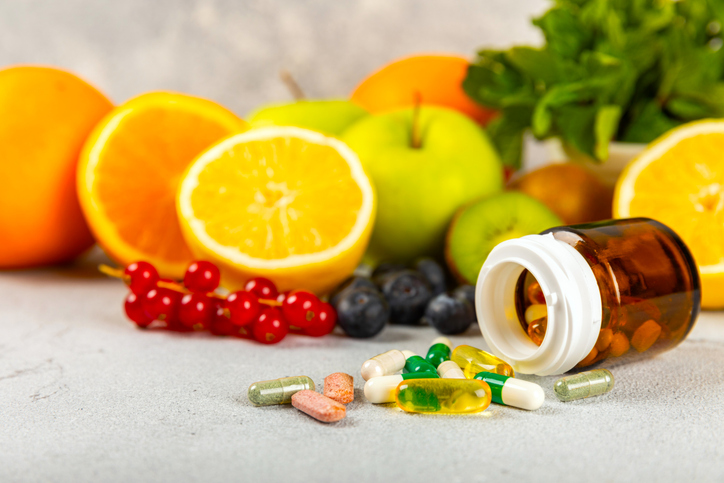
Many people take dietary supplements such as vitamins, minerals, or herbs to improve their health. It is easy to assume these products are safe as they can be readily found in stores and are usually made with natural ingredients. However, supplements are not necessarily safe, especially when taken with medicines. Even if the product is labeled as “natural” or it is something that occurs naturally in our body, there is still a potential for it to cause harm. There are also foods you eat that may interact with the medicines and supplements you take. Let’s look at how food and supplements can interact with medicines.
How do these foods or supplements affect my medicines?
When we take medicines, our body breaks them down using specialized proteins called enzymes. Certain foods and supplements can interact with these enzymes and change the way our body breaks down medicines. In addition, some medicines are prodrugs, which means they only work after the body breaks them down. Some foods and supplements block the enzymes from breaking down the medicine. Others increase how fast the enzyme breaks down the medicine or breaks it down more often. Depending on the type of interaction, the effects of the medicine may be increased, decreased, or lead to side effects. For example:
- Grapefruit/grapefruit juice and Goldenseal block an enzyme that a lot of medicines are broken down by. This causes the amount of medicine in your body to increase because it is not broken down as effectively.
- St John’s wort increases how fast and how often the enzyme breaks down the medicine. This means the amount of medicine in your body may be decreased because it is being broken down faster than normal.
Just like medicines, foods and supplements may cause unwanted side effects such as:
- increasing or decreasing your heart rate
- increasing or decreasing your blood pressure
- bleeding
- making you drowsy or sleepy.
When taken alone and as directed, the risk of these foods or supplements causing serious harm is low. However, when combined with certain medicines, or when taken in very large amounts, the risk of serious interactions and side effects increases.
Here are some examples of foods and supplements that can interact with certain medicines:
- St John’s wort: This herbal supplement interacts with medicines that increase serotonin or act on serotonin receptors (such as antidepressants like sertraline, escitalopram, and duloxetine). Increasing your serotonin level too high can cause your blood pressure, heart rate, and temperature to increase to life-threatening levels. It can also increase your sensitivity to the sun. This can put you at a higher risk for sunburn, especially when taken with other medicines that can increase your sun sensitivity like retinoids, doxycycline, and tacrolimus.
- Aged, fermented, and cured foods: Foods commonly found on a charcuterie board like wine, cured meats, pickles, and aged cheeses are high in a compound called tyramine which can interact with monoamine oxidase inhibitor (MAOI) medicines and can cause your blood pressure to increase to life-threatening levels. MAOI medicines are usually used to treat depression or Parkinson’s disease such as phenelzine, selegiline, or tranylcypromine.
- Dairy products: Foods such as milk, cheese, and yogurt are high in calcium and can bind to certain medicines, making them less effective. Some examples include antibiotics such as doxycycline and ciprofloxacin.
- Leafy, green vegetables: vegetables like spinach, brussels sprouts, and kale are high in vitamin K and can interact with the blood thinning medicine warfarin. Too much vitamin K can lower the effectiveness of warfarin and cause your blood to clot more easily. If you are already eating these vegetables while on warfarin, it is recommended to continue eating these foods as you usually do because an abrupt change (like suddenly eating more than usual or stopping all together) can cause serious effects.
- Dong quai/Garlic/Ginger/Ginkgo/Ginseng/Glucosamine/Vitamin E: these foods and supplements can increase your bleeding risk, especially when combined with blood thinning medicines such as warfarin, apixaban, or clopidogrel.
- Alcohol: can have multiple interactions with medicines such as increased risk of drowsiness, slow or difficulty breathing, fainting, heart problems, and overdose.
- Caffeine: in very high amounts, caffeine can increase your blood pressure and heart rate, especially when combined with other medicines that could increase your blood pressure and heart rate such as stimulants like lisdexamfetamine or mixed amphetamine and dextroamphetamine salts.
Interactions with Sensitive Medicines
Interactions are especially important to avoid when taking a medicine that must be kept at a certain level in your body. Some medicines have what is called a “narrow therapeutic range” meaning it needs to be at a certain level in your body – not too much and not too little. If the amount of medicine in your body is even a little too high or too low, it can cause serious, life-threatening effects. Taking a supplement or food that can change the amount of medicine in your body (like grapefruit or St John’s wort) can be enough to push the medicine level out of its narrow therapeutic range. Some examples of these medicines are:
- Cyclosporine: used to prevent organ transplant rejection
- Digoxin: used for heart failure or abnormal heart rhythm
- Phenytoin: used to prevent seizures
- Warfarin: used as a blood thinner
Interactions with Surgery Medicines
Before having surgery, it is important to talk to your health care provider about any supplements you are taking as soon as possible. Supplements may change the way your body responds to medicine given before, during, or after the surgery and can cause serious, life-threatening effects. Your provider may suggest you stop taking the supplement for a certain amount of time before the surgery.
How can I avoid these interactions?
- Read medicine and supplement labels carefully and understand the warnings for each of the medicines and supplements you take.
- Keep all your health care providers informed about all supplements, herbals, wellness products, over-the-counter medicines, and prescription medicines you take and of any changes to what you eat (e.g., vegetarian, vegan, gluten free, dairy free).
- Ask your health care provider or pharmacist what foods, beverages, and supplements to avoid while taking your medicine(s).
Check with your health care provider or pharmacist before starting a new supplement to know if it is safe to take with your medicines. It is important to know that the U.S. Food and Drug Administration (FDA) does not regulate the safety and effectiveness of supplements. However, the FDA does have the authority to act against any supplements that are mislabeled or contain substances that are not clearly identified after they are available to buy.
If you or someone you know is experiencing a food, supplement, or medicine interaction or have questions about food, supplement, or medicine interactions, call the Maryland Poison Center at 1-800-222-1222.
Melinda Lee, PharmD
Clinical Toxicology Fellow
Maryland Poison Center
University of Maryland School of Pharmacy
Comments are closed.